Method
Quality from a Scene Manifold
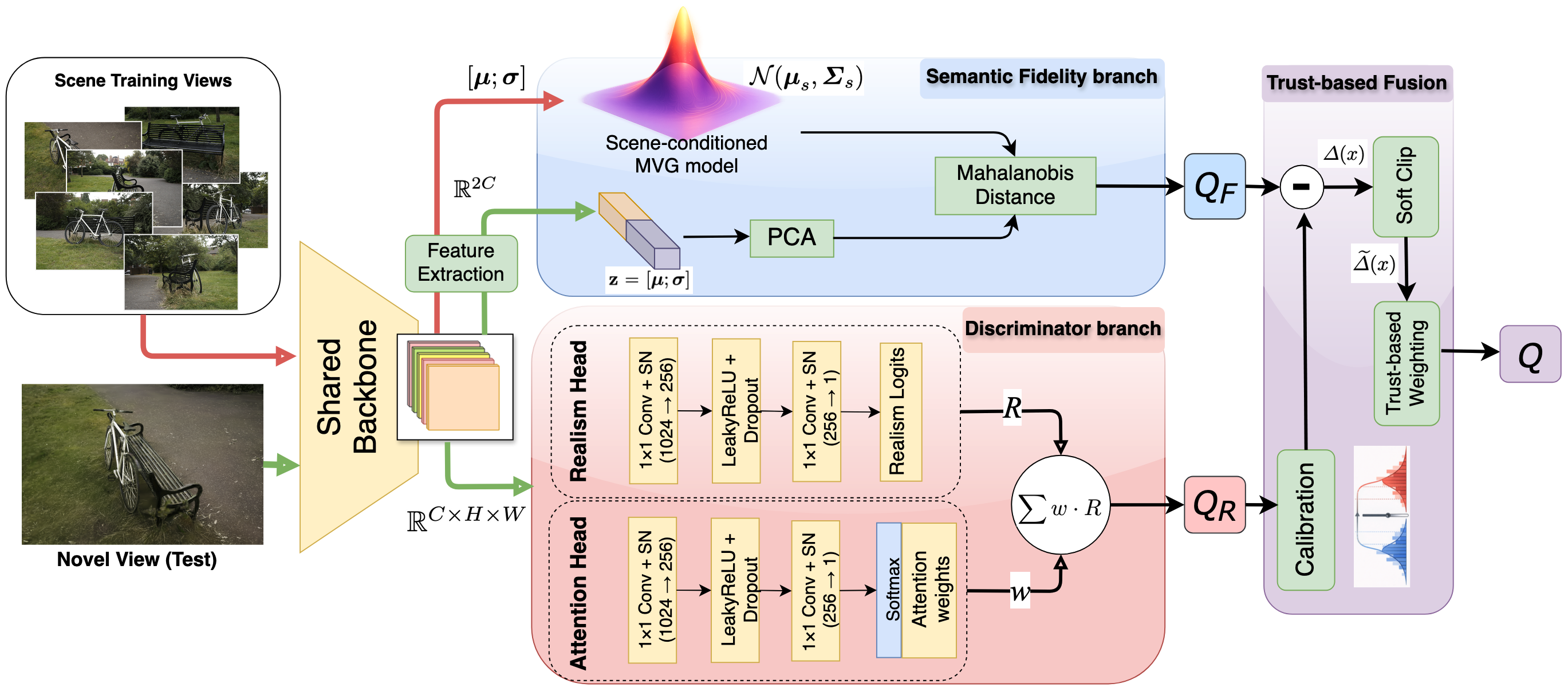
SCODA models each scene using clean reference views. A pretrained CNN extracts semantic features, and a multivariate Gaussian captures the normal distribution of high-quality observations for that scene.
A test rendering receives a fidelity score, QF, from its Mahalanobis distance to this scene model. A lightweight patch discriminator provides QR, a distortion-aware realism cue. The final score applies bounded residual fusion after quantile alignment.
The default mode treats each rendered image as one view. For light fields sampled on a regular angular grid, SCODA can split each view into an N x N patch grid, score local regions, and pool them into one view-level quality estimate.
- Scene-conditionedUses multiple reference views rather than a single aligned image.
- DistributionalRepresents reference content as a scene-specific feature distribution.
- Distortion-awareCombines semantic fidelity with a trained realism signal.
Results
Representative Validation
On the 3DGS-IEval-15K validation set, the scene-conditioned fidelity term and realism term are both strongly correlated with human opinion scores. Their fused score gives the best rank correlation while keeping the method usable without a precisely aligned full-reference image.
| Score | Meaning | SRCC | KRCC | PLCC |
|---|---|---|---|---|
| QF | Scene-manifold fidelity | 0.8819 | 0.6938 | 0.8796 |
| QR | Distortion-aware realism | 0.8716 | 0.6770 | 0.8703 |
| Q | Bounded fused SCODA score | 0.8982 | 0.7154 | 0.8959 |
Code
Run SCODA-QA
python -m venv .venv
source .venv/bin/activate
pip install -r requirements.txt

python run_scoda.py \
  --image /path/to/test.png \
  --scene bicycle \
  --scene-ref-root /path/to/scene_train
Use --spatial-mode image for single rendered views and --spatial-mode grid --grid-size 3
for LF-style patch scoring. Cached stats are checked against the requested mode.
The public repository is available at gitlab.com/saeedmp/scoda.
Citation
Cite
@inproceedings{scodaqa2027,
  title={SCODA-QA: Scene-Conditioned Distributional Quality Assessment for Radiance Fields},
  author={Mahmoudpour, Saeed and Um, Gi-Mun and Choo, Hyon-Gon and Schelkens, Peter},
  booktitle={...},
  year={2027}
}